
4.9 KiB
4.9 KiB
- Test Content
-
AZ-900 Domain Area Weight Describe cloud concepts 25-30% Describe Azure architecture and services 35-40% Describe Azure management and governance 30-35%
-
-
Cloud Concepts
-
Introduction to cloud computing
- Define cloud computing.
- Compute Power
- Storage
- Pay only ressources you use
- Upkeep is done by cloud provider
- Describe the shared responsibility model.
- Cloud Provider: Physical security, power, cooling, and network connectivity are the responsibility
- Consumer: responsible for the data and information stored in the cloud.
- IAAS (Infrastructure)-> PAAS (Platform) -> SAAS (Software)
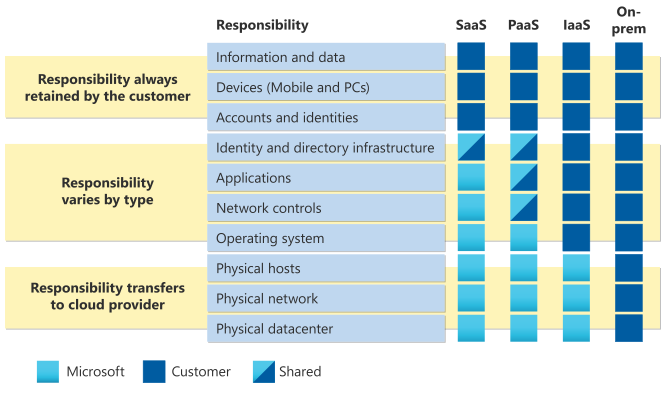 {:height 231, :width 700}
- Define cloud models, including public, private, and hybrid.
-
Public cloud Private cloud Hybrid cloud No capital expenditures to scale up Organizations have complete control over resources and security Provides the most flexibility Applications can be quickly provisioned and deprovisioned Data is not collocated with other organizations’ data Organizations determine where to run their applications Organizations pay only for what they use Hardware must be purchased for startup and maintenance Organizations control security, compliance, or legal requirements Organizations don’t have complete control over resources and security Organizations are responsible for hardware maintenance and updates - Azure ARC
- Manage Cloud environment
-
- Identify appropriate use cases for each cloud model.
- Describe the consumption-based model.
- Capital expenditure (CapEx)
- upfront one time expenditure
- Operational expenditure (OpEx)
- spending money on services or products over time
- Cloud computing is here
- Capital expenditure (CapEx)
- Compare cloud pricing models.
- pay-as-you-go pricing model
- Define cloud computing.
-
Describe the benefits of using cloud services
- Describe the benefits of high availability and scalability in the cloud.
- uptime (or availability)
- demand (or scale)
- Scalability refers to the ability to adjust resources to meet demand
- vertical
- increasing or decreasing the capabilities of resources (i.e. RAM or CPU)
- horizontal
- adding or subtracting the number of resources (i.e. VMs or containers)
- each Service has own SLA
- Describe the benefits of reliability and predictability in the cloud.
- Reliability is the ability of a system to recover from failures and continue to function
- decentralized design and global scale across data centers
- Predictability
- performance predictability
- Autoscaling, load balancing, and high availability
- cost predictability
- track cost in real time
- Total Cost of Ownership (TCO) or Pricing Calculator
- performance predictability
- Reliability is the ability of a system to recover from failures and continue to function
- Describe the benefits of security and governance in the cloud.
- Set templates
- update all your deployed resources to new standards
- Cloud-based auditing
- handle distributed denial of service (DDoS)
- Describe the benefits of manageability in the cloud.
- Automatically scale resource
- Deploy resources based on (preconfigured) templates
- Monitor health and replace failing resources
- Automatic alerts
- Use
- Web Portal, CLI, APIs, PowerShell
- Describe the benefits of high availability and scalability in the cloud.
-
Describe cloud service types
- Describe Infrastructure as a Service (IaaS).
- renting the hardware in a cloud datacenter (i.e. Hetzner)
- Scenarios
- Lift-and-shift migration
- Test an development
- Describe Platform as a Service (PaaS).
- maintain the operating systems, databases, and development tools
- Scenarios
- Development framework
- Analytics or business intelligence
- Describe Software as a Service (SaaS).
- Use Maintained Software
- Scenarios
- Email and messaging.
- Business productivity applications.
- Finance and expense tracking.
- Identify appropriate use cases for each cloud service (IaaS, PaaS, SaaS).
- Describe Infrastructure as a Service (IaaS).
-
-
Azure architecture and services
-
Describe the core architectural components of Azure

-
Describe Azure regions, region pairs, and sovereign regions.
- Describe Availability Zones.
- Describe Azure datacenters.
- Describe Azure resources and Resource Groups.
- Describe subscriptions.
- Describe management groups.
- Describe the hierarchy of resource groups, subscriptions, and management groups.
-